Funeral Director Suits Built for the 24/7 Service Cycle
Bespoke mortuary attire with embroidered nameplates, fleet replenishment, and online self-measure — shipped to every chapel for half the domestic MTM price.
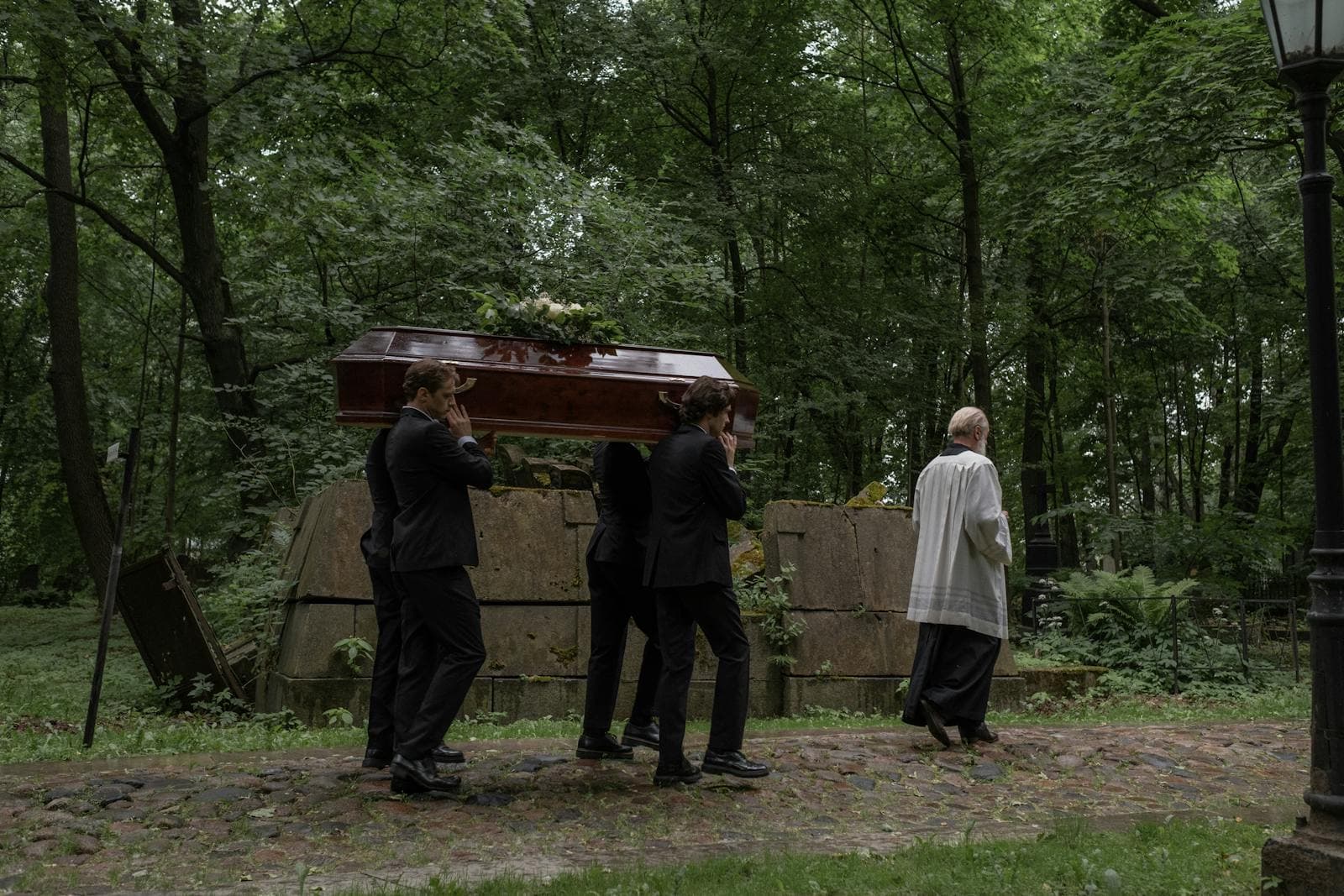
funeral director suits
The Funeral Homes Uniform Reality
A funeral director's suit is not a wardrobe item. It is occupational equipment worn through fourteen-hour days that begin with a 6 a.m. removal call, transition into 10 a.m. visitations, pivot to a graveside service in a working cemetery by 1 p.m., and end with a family arrangement conference at 8 p.m. Between those shifts, the same suit moves through embalming-room corridors, the prep-room threshold, and the parking-lot handoff to the hearse driver. Cot lifts, casket transfers, and kneeling at the side of grieving families place mechanical demands on shoulder seams, knee linings, and trouser inseams that no off-the-rack garment is engineered to absorb.
The cultural expectation compounds the wear. Most independent homes maintain an unwritten 24/7 dark-suit policy: directors are reachable around the clock, and an overnight transfer demands the same dignity of presentation as a 2 p.m. service. NFDA's regional conventions — the Mid-States in Indianapolis, the Northeast Forum in Atlantic City, the International Convention each October in Las Vegas — reinforce a uniform aesthetic across the profession: navy or charcoal, two-button notch lapel, white pocket square, embroidered lapel nameplate. With NFDA reporting that more than 50% of active directors are over 50 and a 12-18% annual turnover rate from succession transitions, fleet planning is now a recurring operational line item, not a one-time hire decision.
Why Current Procurement Is Broken
Where every existing supplier fails this buyer
Multi-location independents — the two-to-eight-chapel families running half of America's at-need volume — fall into a procurement gap. SUITSandBLAZERS publishes a serviceable catalog but treats each suit as a one-off transaction; there is no replenishment cadence, no saved measurements, no design template that survives a director leaving the firm. Men's Wearhouse and Jos. A. Bank rental programs explicitly prohibit lapel embroidery and customer-supplied nameplates, which gut the entire purpose of service identification. Town & Country Uniforms ships standard sizing without bespoke fit. B. Brook Ltd dominates search results — but for burial suits sold to funeral homes for the deceased, which clogs procurement research with the wrong intent. Local tailors will fit one director beautifully and then quote $1,400 per suit at five-suit rotation across twelve directors — math no family-owned home can absorb when SCI and Dignity Memorial enjoy national vendor contracts they cannot access.
The Nathan Tailors Approach
Nathan Tailors delivers bespoke funeral director suits at roughly half the domestic MTM benchmark — a fully canvassed two-piece in VBC or Marzotto wool lands at $300-$500 versus the $1,000-$1,400 a regional MTM house quotes for comparable construction. The mechanism is straightforward: we are a Hoi An atelier with a 25-year operating history, no US retail overhead, and a measurement workflow built for clients who never set foot in our shop. A new director onboarded at your Cleveland chapel self-measures in 18 minutes through our guided online flow, uploads photos for our team to review, and receives a fitted kit at her chapel address in three to four weeks. Every measurement is saved against a firm-level account. Reorders pull the same template — same fabric SKU, same buttoning point, same lapel width, same embroidered nameplate font — so the fifth suit a director receives in year three matches the first. We ship to any chapel address in the US, UK, and Canada.
For operators who already understand supply chain
The Supply Chain Open Secret
What sharp operators have always known about “domestic” uniform pricing.
Most “American-made” or “British-tailored” corporate uniform programs are cut and sewn in Vietnam, Bangladesh, or China — then marked up three to five times between the factory and your invoice. The Brooks Brothers corporate suit. The Hugo Boss store program. The hotel uniforms at the property down the street. They all start within a few hundred miles of our atelier in Hoi An.
We are the factory-direct version of that supply chain. Same Italian wool — Vitale Barberis Canonico, Reda, Marzotto. Same hand-finished construction, same lapel canvas, same hand-stitched buttonholes. We just don't have the US distribution layer between us and your loading dock.
The funeral homes operators who run our program tend to be a particular type. The ones who built their margin by cutting middlemen out of their P&L. The ones who instinctively recognize when a price reflects actual cost versus brand mark-up. They run our program quietly. When a peer at a conference compliments their team's uniforms, they smile, say “thanks,” and maybe lean in for the longer conversation about how to do the same.
How Funeral Homes Use the Program
Real workflows we run for procurement teams in this category
Multi-Location Fleet Replenishment
A 3-chapel home with 12 directors orders 8-12 replacement suits per year against a saved firm template. We hold fabric reservations from Vipiteno (VBC) and Marzotto for 90 days, lock the design spec at the firm level, and ship directly to the chapel needing the inventory. No annual catalog negotiation, no repeat measurements for returning directors, no fit drift between Cleveland and Cincinnati.
New-Director Onboarding Kit
When a new licensee joins, the firm's owner triggers a 5-suit onboarding kit through the saved firm account. The director self-measures online from her apartment, our team reviews the photo submission within 48 hours, and the kit arrives in 3-4 weeks with embroidered nameplate, two house-color ties, and a black overcoat option. She is service-ready before her 90-day probationary review.
Season-of-Grief Peak Coverage
Q4 and January flu season drive 30-40% volume spikes at most US homes. Suits cycle through dry cleaning faster, hems blow out from cemetery work in winter mud, and lapel rolls collapse. Firms running our program pre-order a Q3 replenishment wave — typically 15-20% of total fleet — so directors enter peak season in fresh rotation rather than hiding shine and worn knees under topcoats.
Pre-Need Consultant Attire
Pre-need sales consultants meet families in living rooms, not chapels. The presentation context calls for a softer construction — half-canvassed, slightly lighter wool, often a navy chalk stripe rather than solid charcoal. We maintain a parallel template for pre-need staff that reads consultative rather than ceremonial, while preserving the firm's embroidered lapel identity for brand continuity.
How We Compare to Existing Suppliers
Honest read of where each incumbent works — and where they don't
SUITSandBLAZERS
Their pitch
Catalog tailor positioning itself as the default funeral director uniform supplier with a dedicated mortuary attire page.
Where they fall short
No fleet account, no saved measurements, no replenishment cadence. Each suit is a fresh transaction. A multi-location home re-measures every director every order, and there is no design template that survives staff turnover.
B. Brook Ltd
Their pitch
Long-established supplier serving the funeral profession, ranks aggressively on funeral-related search terms.
Where they fall short
Their primary catalog sells burial suits — garments dressed on the deceased — not service uniforms for staff. Procurement teams researching director attire surface their listings and waste an hour confirming the wrong intent.
Town & Country Uniforms
Their pitch
Service-industry uniform house with a funeral home line covering directors, attendants, and pallbearers.
Where they fall short
Standard sizing only — no bespoke construction, no fit refinement for the 6'5" director or the 5'4" arrangement counselor. No fleet program, no embroidered lapel nameplate workflow, no firm-level account structure.
Men's Wearhouse Corporate
Their pitch
National chain with a corporate uniform program and a perception of scale advantage.
Where they fall short
Rental program contracts explicitly prohibit lapel embroidery and customer-supplied nameplates. Purchase program is off-the-rack with limited bespoke fit. Pricing for multi-location independents matches retail — no fleet discount that family-owned homes can actually access.
Nathan Tailors
Our pitch
Bespoke construction, online self-measure, repeatable design template, fleet pricing — direct from a Hoi An atelier with 25 years of operating history.
What this unlocks
Roughly 50% lower per-suit cost than US/UK MTM, identical fleet specs across every reorder, no in-person fittings, ship to office or staff homes globally.
The Math, on a Real Order
12-director, 3-location funeral home, 5-suit rotation per director, replaced every 24 months
Domestic MTM Supplier
$72,000
12 staff × 5 suits × $1,200 per suit
Nathan Tailors Program
$30,000
Same staff count, same suit volume, at $500 per bespoke suit
Total program savings on this scenario
$42,000
Reinvested into staff training, refresh frequency, or simply protected margin
How It Works
From first quote to staff fully outfitted — typically 5 to 7 weeks end-to-end.
Design Brief
Send your spec, brand colors, mood board. We confirm fabric library, silhouette, and crest/embroidery within 72 hours.
Sample Round
One sample garment built to a nominated staff member. Worn for fit, drape, brand-color verification before fleet production.
Self-Measure
Each staff member completes our 12-step guided online flow on their phone. 8–10 minutes per person, no in-person fitting.
Production & Ship
Bespoke production in our Hoi An atelier, then shipped to your office or directly to staff. Full international tracking.
Funeral Homes Procurement FAQ
Common questions from funeral homes buyers evaluating our program
How does self-measurement work for directors with non-standard body types?
Our guided online flow captures 22 measurements with photo and video review. We have fitted directors from 5'2" to 6'8", 130 lbs to 340 lbs, with documented accuracy on athletic-build, postural-asymmetric, and post-surgical body types. Submissions are reviewed by a senior fitter within 48 hours, and we request a re-measure on any data point that reads off-pattern before cutting fabric.
What is the lead time when a director needs an emergency replacement?
Standard production is 3-4 weeks plus 5-7 days transit. For emergency replacements against a saved firm template, we can compress production to 10-14 days and air-freight to a chapel address in the US, UK, or Canada within 3 days. Firms running an active fleet program typically maintain a one-suit reserve per director to bridge the gap.
Can you embroider lapel nameplates and firm identification?
Yes. Embroidered lapel nameplates are included at no additional cost on every funeral director suit. We maintain a saved font, thread color, and placement spec at the firm level so the third Daniel Reeves you order for in year four matches the first. Firm crests, AA pins, and NFDA member insignia can also be embroidered or pin-mounted as specified.
Which fabrics survive the 24/7 wear cycle?
We recommend a 280-320g Super 110s or 120s wool from VBC (Vipiteno) or Marzotto for the primary rotation — heavy enough to hold structure through cot lifts and humid graveside services, fine enough to dry-clean on a 14-day cycle without surface degradation. We avoid Super 150s+ for funeral home use; the higher yarn count reads beautifully but does not survive the wear pattern.
What if the first-time fit is not right?
We refit at no charge. If alterations under 1.5 inches resolve the fit, we credit a local tailor up to $80 per suit. If the fit is structurally off — shoulder, chest, or trouser rise — we remake the garment from scratch and pay return shipping. In 25 years, our remake rate sits at roughly 2.8% of orders.
Is there a minimum order quantity?
No. A two-suit order for a single new director is welcomed at the same per-unit price as a forty-suit fleet wave. Pricing reflects construction cost, not order volume — which is part of why family-owned independents can match the per-suit economics that publicly-traded chains negotiate through national contracts.
Do you offer net-30 billing for multi-location homes?
Yes. After a first paid order, we extend net-30 terms to firms with three or more chapel locations, with consolidated monthly invoicing across all addresses. Larger fleet accounts can be structured as net-45 against a signed annual replenishment forecast. Payment by ACH, wire, or corporate card.
Where We Meet Funeral Homes Procurement Teams
NFDA International Convention (October, Las Vegas) — 6,000 funeral directors, vendor exhibition, the canonical procurement channel.
Other Corporate Uniform Programs
Ready for a Corporate Quote?
Tell us your headcount, your role mix, and your brand brief. We'll come back within 72 hours with a fabric story, a sample plan, and a delivered cost per uniform — no obligation.
For procurement teams: net-30 terms available after first paid order. We invoice in USD, GBP, or CAD.