Boutique Hotel Uniforms Designed With You, Tailored In Hoi An
Mood-board collaboration, Vitale Barberis and Reda fabric library, sample-and-iterate process — uniforms that extend your property's design language, not contradict it.
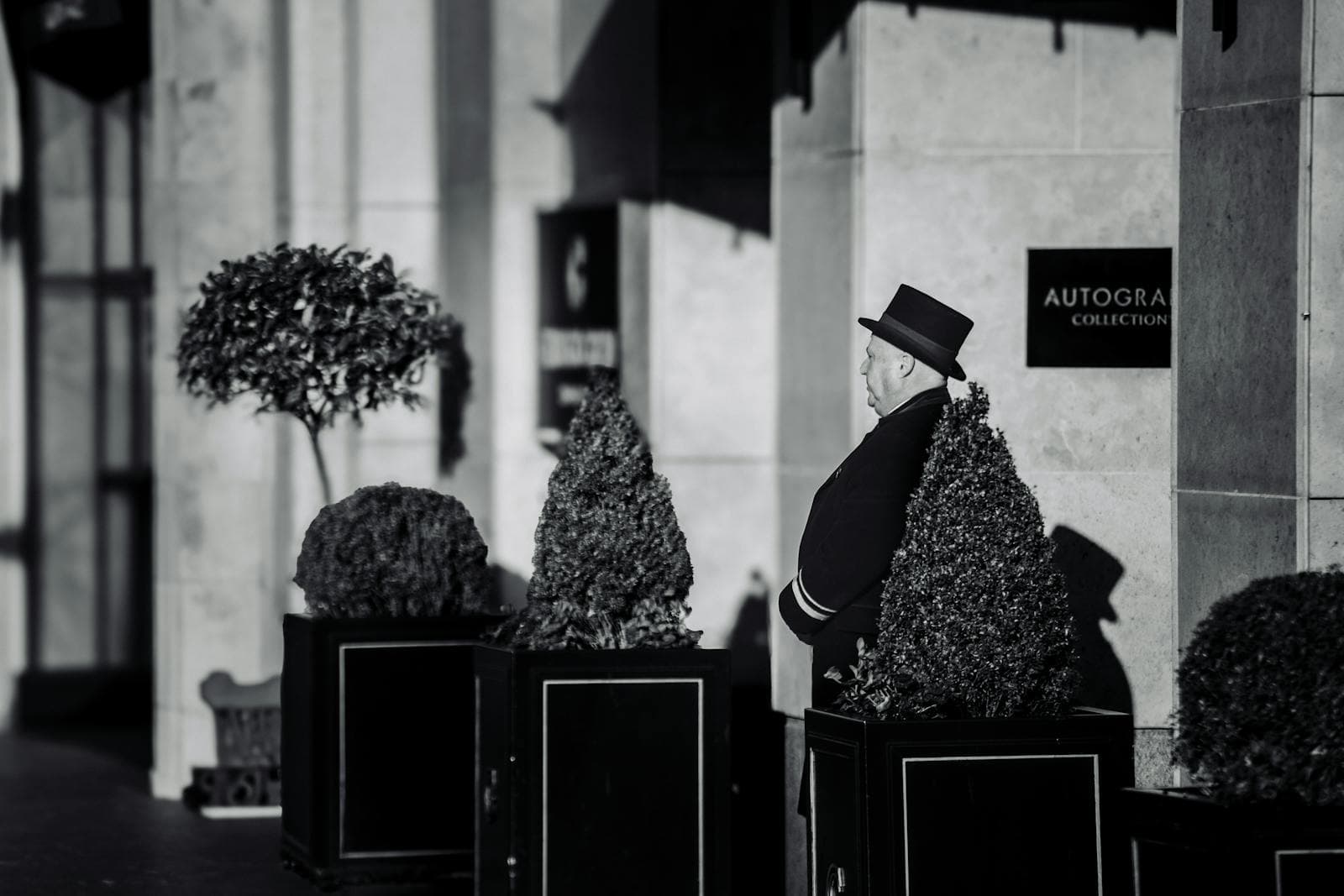
boutique hotel uniform supplier
The Boutique Hotels Uniform Reality
The independent luxury hotel of 2026 is no longer measured by thread count alone. It is measured by coherence — the moment a guest walks through the lobby, a doorman's lapel, a concierge's waistcoat, and a sommelier's apron must read as deliberate continuations of the architecture itself. The wood-paneled lobby of an urban-design hotel in Brooklyn calls for a different silhouette than the cane-and-rattan veranda of a coastal property in Tulum, and both diverge sharply from the loden wool aesthetic of an alpine lodge in Telluride. Front-office uniforms are not procurement line items. They are interior elements that move.
This is the gap most uniform suppliers misread. The boutique hospitality buyer — typically a GM partnered with a Brand or Creative Director — is fluent in design vocabulary. They speak in silhouette and drape, in gauge and hand-feel. They reference linen-blends with the same specificity an architect references white oak versus walnut. Their property may sit within the BLLA orbit, or operate as part of a Soho House, Faena, or Ace-adjacent footprint, but in every case the brief is the same: hospitality uniform programs that read as authored, not assembled. Fabric weight matters. Lapel width matters. The way a bellman jacket falls when he reaches for a suitcase matters. Anything less reads as a costume rented for the role.
Why Current Procurement Is Broken
Where every existing supplier fails this buyer
Studio 104 builds beautiful work for Mandarin Oriental, Raffles, and the Dorchester — and prices accordingly. For an 80-key boutique opening, the per-uniform invoice can rival the FF&E line for guest rooms. KAPTVA produces design-led hospitality uniforms, but quoting cycles routinely outrun property opening calendars; properties scheduled for May commissioning find themselves negotiating fabric in March. NO Uniform London delivers heritage and slow craft, with quote-to-confirm cycles measured in four-week email exchanges before a single sample lands. Top Hat Imagewear and Stock Mfg solve the corporate uniform brief efficiently — embroidered polos, pleated chef coats, name-tag-friendly oxfords — but their lookbooks read as conference-center, not boutique. None of them sit comfortably in the gap between Aman pricing and Cintas aesthetics, which is precisely where the independent luxury property lives.
The Nathan Tailors Approach
We work the way a creative director already works. Send the mood board. Pinned interior renders, fabric tear-sheets, the silhouette references from the Met Costume archive, the Pinterest grid of a competing property's bellman line. Within seventy-two hours we return a fabric story drawn from our Italian mill library — Vitale Barberis Canonico for structured wool, Reda for tropical-weight worsteds, Dormeuil for the statement waistcoat, mid-weight Belgian linen for coastal coordinates. We photograph swatches against your interior palette before a single garment is cut. Sample-and-iterate is not optional; it is the process. One concierge jacket, one waistcoat, one trouser arrives at the property for fit, drape, and brand-color verification before the fleet enters production. Twelve-piece minimum. Factory-direct from Hoi An. Price sits at roughly $200-400 per two-piece — a fact, not a pitch.
For operators who already understand supply chain
The Supply Chain Open Secret
What sharp operators have always known about “domestic” uniform pricing.
Most “American-made” or “British-tailored” corporate uniform programs are cut and sewn in Vietnam, Bangladesh, or China — then marked up three to five times between the factory and your invoice. The Brooks Brothers corporate suit. The Hugo Boss store program. The hotel uniforms at the property down the street. They all start within a few hundred miles of our atelier in Hoi An.
We are the factory-direct version of that supply chain. Same Italian wool — Vitale Barberis Canonico, Reda, Marzotto. Same hand-finished construction, same lapel canvas, same hand-stitched buttonholes. We just don't have the US distribution layer between us and your loading dock.
The boutique hotels operators who run our program tend to be a particular type. The ones who built their margin by cutting middlemen out of their P&L. The ones who instinctively recognize when a price reflects actual cost versus brand mark-up. They run our program quietly. When a peer at a conference compliments their team's uniforms, they smile, say “thanks,” and maybe lean in for the longer conversation about how to do the same.
How Boutique Hotels Use the Program
Real workflows we run for procurement teams in this category
Property Opening Uniform Fleet
A 90-key independent resort scheduled for soft opening in five months commissions front-office, F&B, and spa uniforms in a single coordinated brief. Eighty-to-one-hundred-fifty pieces across doormen, front desk, concierge, hosts, servers, sommeliers, and pool-deck attendants. We compress the cycle: mood board week one, fabric story week two, samples weeks three through five, fleet production weeks six through fourteen, shipping and on-site fittings weeks fifteen through sixteen. The GM receives one production calendar and one point of contact rather than coordinating five vendors.
Brand Refresh After Creative Director Hire
A property under five years old brings in a new Brand or Creative Director and the existing uniform program — often inherited from the original GC or a corporate parent — reads as out-of-step within ninety days. We rebuild from the new visual identity: revised silhouette, lapel geometry, fabric hand, button work, and trim language. Existing staff sizes are already on file from the prior program, which collapses re-measurement and lets the refresh ship in six-to-eight weeks rather than the typical opening cycle.
Concierge and F&B Coordinated Suite
The most common boutique brief is a single uniform language across front-of-house. Concierge in a structured wool single-breasted jacket with contrast waistcoat, host in matched waistcoat without jacket, server in waistcoat plus tailored trouser, sommelier in the same waistcoat plus a tournée-cut Belgian linen apron in a deeper companion shade. One fabric library, four roles, one visual line. Lapel pin and pocket-square detailing tie back to the property's monogram or signature color.
Coastal-Property Linen Specification
Resort properties in Florida, the Caribbean, Baja, or Southeast Asia require a fabric specification most domestic suppliers cannot source at scale. We work primarily in 60/40 and 70/30 linen-cotton blends from Italian and Belgian mills, garment-washed for softness, with a higher armhole and softer canvas to allow valet and bell staff to lift, bend, and stretch through eight-hour shifts in eighty-five-degree humidity without the jacket telegraphing wear by the third hour.
How We Compare to Existing Suppliers
Honest read of where each incumbent works — and where they don't
Studio 104
Their pitch
Premium hospitality design house with a portfolio anchored on Mandarin Oriental, Raffles, and the Dorchester Collection. Fabric, fit, and finish are unimpeachable.
Where they fall short
Pricing is calibrated to the global flagship tier. For an independent boutique with eighty-to-one-fifty staff, the per-uniform invoice can collide with FF&E and operating-supplies line items in ways the GM cannot defend to ownership.
KAPTVA
Their pitch
Design-priced luxury hospitality uniforms with a strong creative-director-friendly aesthetic and a recognizable visual signature.
Where they fall short
Lead times and quoting cycles regularly miss property opening windows. Boutique openings operate on four-month uniform horizons; quotes that take six weeks to confirm leave the GM short on production runway.
NO Uniform London
Their pitch
Heritage British tailoring applied to hospitality, with slow-craft positioning and a London atelier process.
Where they fall short
The quote-to-confirmation cycle is measured in four-week email exchanges before a sample is even cut. For a property opening on a fixed calendar or a creative director refreshing in-season, the pace is structurally incompatible.
Top Hat Imagewear
Their pitch
New York-based corporate uniform supplier with broad capability across hospitality, healthcare, and corporate ID programs.
Where they fall short
Lookbook and house silhouette read as conference-center and corporate-event — competent for chain hotels, but the visual language sits at odds with what a boutique creative director is trying to author. The buyer wants editorial, not embroidered polo.
Nathan Tailors
Our pitch
Bespoke construction, online self-measure, repeatable design template, fleet pricing — direct from a Hoi An atelier with 25 years of operating history.
What this unlocks
Roughly 50% lower per-suit cost than US/UK MTM, identical fleet specs across every reorder, no in-person fittings, ship to office or staff homes globally.
The Math, on a Real Order
120-staff boutique resort opening, jacket + waistcoat + trouser per staff, 30% annual turnover
Domestic MTM Supplier
$270,000
120 staff × 1.5 suits × $1,500 per suit
Nathan Tailors Program
$108,000
Same staff count, same suit volume, at $600 per bespoke suit
Total program savings on this scenario
$162,000
Reinvested into staff training, refresh frequency, or simply protected margin
How It Works
From first quote to staff fully outfitted — typically 5 to 7 weeks end-to-end.
Design Brief
Send your spec, brand colors, mood board. We confirm fabric library, silhouette, and crest/embroidery within 72 hours.
Sample Round
One sample garment built to a nominated staff member. Worn for fit, drape, brand-color verification before fleet production.
Self-Measure
Each staff member completes our 12-step guided online flow on their phone. 8–10 minutes per person, no in-person fitting.
Production & Ship
Bespoke production in our Hoi An atelier, then shipped to your office or directly to staff. Full international tracking.
Boutique Hotels Procurement FAQ
Common questions from boutique hotels buyers evaluating our program
How does the mood-board iteration process work in practice?
You send what you already have — pinned interior renders, fabric tear-sheets, silhouette references, even a competitor's bellman line. We respond within seventy-two hours with a fabric story drawn from our Italian and Belgian mill library, paired against your interior palette in photographed swatch sets. From there we iterate by image: lapel geometry, button work, contrast piping, waistcoat back fabric, trim language. Most properties land their fabric and silhouette direction in two-to-three rounds before any sample is cut.
Can we see fabric and swatches before committing to the program?
Yes, and we recommend it as a non-negotiable step. We ship a curated swatch box drawn from our active mill library — Vitale Barberis Canonico, Reda, Dormeuil, plus our Belgian linen and tropical-weight worsted programs — keyed to your mood board and interior palette. Properties typically receive between twelve and twenty swatches in the first round, narrowed to four-to-six in the second. The swatch box ships free of charge, and the swatches are cut at sufficient size to drape against millwork, upholstery, and stone samples already on the property's design library.
What is the sample lead time before fleet production begins?
Two-to-three weeks from confirmed fabric and silhouette to a single concierge or front desk sample landing at the property. The sample is built to one nominated staff member's measurements and is meant to be worn for fit, drape, brand-color verification, and a full eight-hour shift trial. We adjust off the worn sample — typically lapel width, sleeve length, jacket length, and trouser break — before the fleet enters cut. Fleet production then runs six-to-twelve weeks depending on volume, with shipping in the final two-week window.
How do you match brand colors precisely across fabric and trim?
We work from your brand guidelines — Pantone references, hex values, or physical brand swatches the property sends in. Our mill partners can dye-to-order on linen and cotton-blend programs at higher minimums; for wool and worsted programs we draw from existing mill colorways and color-match through fabric layering, contrast piping, lining, and trim. Where exact match is non-negotiable, we photograph dyed swatches in your interior lighting conditions before approval.
How do you coordinate with a property opening calendar?
Backwards from the soft-opening date. A four-month runway is comfortable; three months is workable; under three is rush territory and we say so honestly. The standard cadence — mood board, fabric story, sample, fleet production, shipping, on-site fittings — runs sixteen weeks. We hold one production slot for confirmed openings, run weekly status calls with the GM and Brand Director, and flag any slippage at the swatch and sample gates rather than at fleet production, where slippage is uncorrectable.
Can front-office and F&B uniforms share one design language?
This is the most common brief we receive, and the most rewarding to build. One fabric library — typically a structured wool for outerwear and a lighter worsted or linen-blend for indoor service — extends across concierge, front desk, host, server, and sommelier. Waistcoats become the connective tissue: same waistcoat, fewer layers as you move from front door to dining room. Sommelier aprons cut from a deeper companion fabric tie the F&B program back to the front office without literal matching.
Do you offer vintage, artisan, or non-standard fabric specifications?
Yes — within the mill library, and beyond it. Hoi An sits at the center of a Vietnamese textile tradition that includes hand-loom silk, indigo-dyed cotton, and artisan weaving still done at village scale. For a property leaning into a regional or heritage aesthetic — a coastal resort with a craft narrative, an urban hotel with an artisan-collaboration brief — we can blend Italian mill fabrics for structured pieces with locally woven accents on linings, pocket squares, apron ties, and trim.
Where We Meet Boutique Hotels Procurement Teams
BLLA Conference (Boutique Lifestyle Leaders Association) — annual gathering where boutique GMs and Creative Directors evaluate next-cycle uniform programs.
Other Corporate Uniform Programs
Ready for a Corporate Quote?
Tell us your headcount, your role mix, and your brand brief. We'll come back within 72 hours with a fabric story, a sample plan, and a delivered cost per uniform — no obligation.
For procurement teams: net-30 terms available after first paid order. We invoice in USD, GBP, or CAD.