
The Met Gala is on May 4, 2026. Sixteen days from when I am writing this. The theme is Costume Art. The dress code: Fashion Is Art. The Costume Institute exhibition is asking, in plain English, whether the clothes we wear belong in the same museum rooms as the paintings and sculptures. Whether a silhouette can be a composition. Whether a seam can be a brushstroke.
The art world has been arguing about this for a hundred years. The fashion world settled it in 1983, when Diana Vreeland staged Yves Saint Laurent: 25 Years of Design at the Met -- the first Costume Institute show dedicated to a living designer -- and a line of traditionalists fainted in public. The argument is over. Fashion is art. The 2026 theme is not asking a question. It is taking a victory lap.
But here is the part nobody in the fashion media is going to say out loud on May 4. The Met Gala is going to celebrate "Fashion Is Art" by parading gowns that cost $40,000 and jackets that cost $15,000 down a red carpet, and everyone is going to applaud as if the price tag is what made them art. That is backwards. The art was never in the label. The art was always in the construction. And the construction -- the thing the Met is actually honoring -- has been happening quietly in workshops like ours, in Hoi An, for generations, at a price that would embarrass the houses on Fifth Avenue.
This is the argument I want to make.
The Argument: Tailoring Is the Art Form. The Met Caught Up.
The Met Gala did not make tailoring cool. Tailoring was cool for 300 years before the Met had an opinion. Savile Row started cutting coats for the British aristocracy in the 1740s. The Neapolitan school perfected the soft shoulder in the 1920s. The Milanese mills -- Vitale Barberis Canonico, Marzotto, Reda -- have been weaving the same wools for five, six, seven generations. The craft existed long before "costume" was a word the Met used for anything other than Halloween.
What the Met has been doing, slowly, over the last decade, is catching up to an argument tailors have been making since they first put a piece of horsehair canvas between two layers of wool. The argument is this: a suit is not a commodity. A suit is a three-dimensional object that exists in relation to a body, built layer by layer through decisions that have nothing to do with a sewing machine and everything to do with the intelligence of a human hand. Sculptors call that "practice." Painters call it "craft." Tailors just call it Tuesday.
The Met finally said it out loud in 2025.
The 2025 "Tailoring Black Style" Moment
Last May, the Costume Institute opened Superfine: Tailoring Black Style -- the first menswear-focused Met exhibition since 2003's Bravehearts: Men in Skirts. Twenty-two years. A whole generation of menswear had come and gone before the Met decided to look at a suit as seriously as it had been looking at gowns.
The exhibition was built around Monica L. Miller's book Slaves to Fashion: Black Dandyism and the Styling of Black Diasporic Identity, and it traced the long arc of Black tailoring -- from the dandies of 18th century London, through the Harlem Renaissance, through the civil rights era, through hip-hop, through today -- as a deliberate, political, architectural form of self-invention through cloth. The co-chairs were Colman Domingo, A$AP Rocky, Lewis Hamilton, and Pharrell Williams. The dress code was "Tailored for You." LeBron James was honorary chair.
Walk through that show and what you saw, over and over, was construction. Padded shoulders that shifted a man's silhouette by a full inch. Lapels rolled by hand. Trousers with a rise that reshaped a waist. Buttons positioned with the kind of obsessive precision that only makes sense if you believe the placement of a button matters -- which tailors do, and which the curators at the Met, for the first time at that scale, were asking the public to believe too.
Critics called it a "seismic" moment for menswear. Vogue covered it as a generational shift. The gift shop sold out of the catalog. And the energy from that show -- the cultural permission slip it handed menswear -- is still riding in April 2026. It is the reason the 2026 theme broadens to "art + body" without losing the thread. The Met opened the door for tailoring in 2025. In 2026, it is just asking you to walk through.
So What Does "Art" Actually Mean in a Suit?
Here is where the essay gets technical, because the argument does not work without the specifics. If a suit is art, the art has to live somewhere. Let me show you where.
The Canvas
Inside every well-made jacket, between the outer wool and the inner lining, there is a layer of horsehair canvas -- a fabric woven from horse mane and wool or cotton, stiff enough to hold a shape, pliable enough to move with a body. In a fused suit (most things under $500), this canvas is replaced with a heat-activated synthetic interlining that is glued to the outer cloth with adhesive. Fast, cheap, structurally dead. The suit cannot learn your body because there is nothing alive inside it to learn.
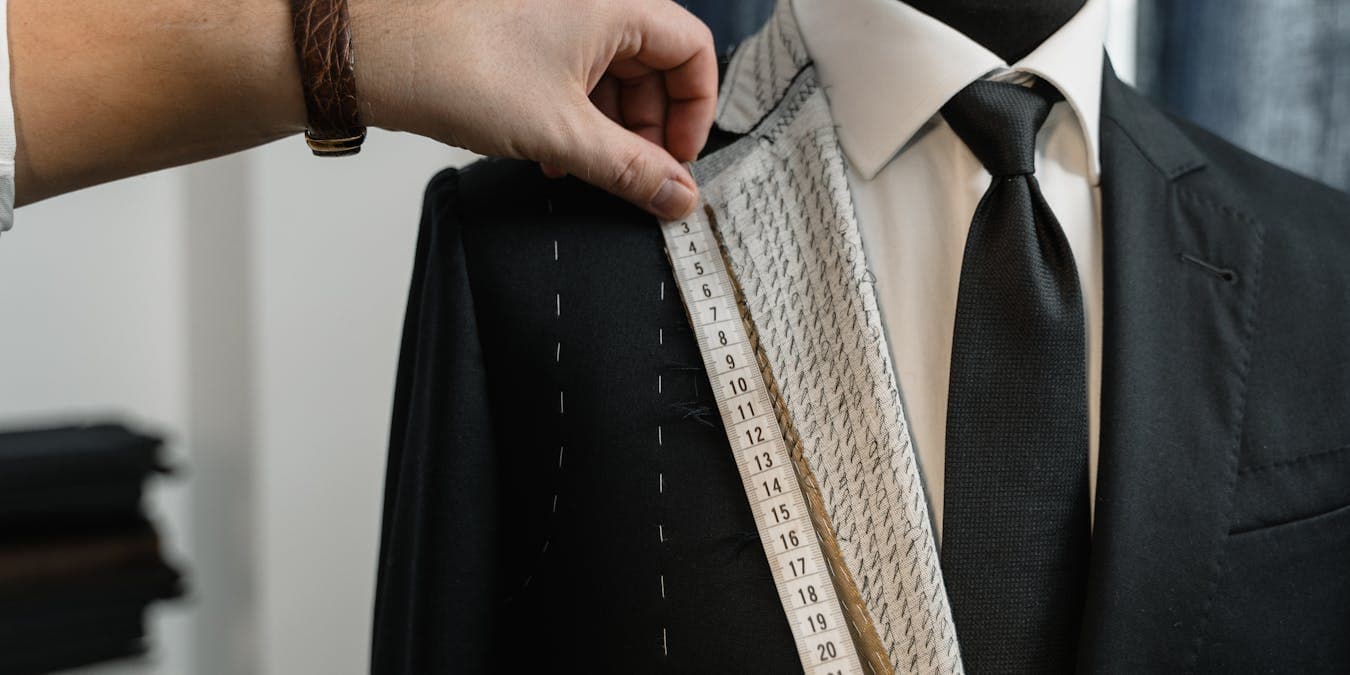
In a canvassed suit, that horsehair is attached to the wool through pad stitching -- thousands of tiny, angled stitches, often 8 to 10 per inch, each one pulled just tightly enough to curve the canvas into a three-dimensional shape. The stitches are invisible from the outside. You only see the result: a chest that sweeps out over your ribs, a lapel that rolls instead of folds, a shoulder that sits naturally instead of perching like a piece of armor.
That pad stitching is sculpture. That is not a metaphor. A tailor building the chest of a jacket is shaping a two-dimensional piece of cloth into a three-dimensional form through repeated, calibrated tension. Michelangelo did the same thing with a chisel. The Met would hang a piece of 18th-century pad stitching behind museum glass and call it textile art. We sew it into the inside of a jacket and nobody sees it for the rest of the garment's life. That is the art. That is what is being honored.
The Lapel
A lapel is not a decoration. A lapel is a structural decision. How wide (a peak lapel in 2026 runs 3.5 to 4 inches for the fashion-forward cut, 3.25 inches for classic proportion)? How high does the gorge sit (the notch where the collar meets the lapel -- 2026 trends are pushing it up toward the collarbone)? How deep is the break in the roll (where the lapel folds over itself before meeting the top button)?
On a bespoke jacket, the lapel is hand-rolled. That means the tailor sews a line of tiny running stitches -- called pick stitching -- around the edge of the lapel by hand, using a waxed silk thread. The stitches are about 3 millimeters long and sit about 6 millimeters from the edge. From two feet away you cannot see them. From six inches away, they are the reason the lapel has life, the reason the edge is not flat and dead like a business card.
Pick stitching takes about 45 minutes per jacket. A machine can approximate it in 4 minutes, but a machine cannot vary the tension to account for how the fabric wants to behave in different spots -- wool near the gorge has a different grain direction than wool on the outer edge, and a human hand knows this, and a human hand adjusts. A machine does not.
This is the thing the Met calls art. It is also the thing SuitSupply does not do below $999. It is also the thing we do at $179.
The Proportional Math
Here is something almost nobody talks about in fashion writing: a suit that looks "right" is obeying a set of proportional rules that are older than photography. The golden ratio. The classical canon of the human figure. The 8-head proportion that Leonardo drew in the Vitruvian Man. A good tailor is running these numbers without writing them down, because after 20 years they live in the hands.
The classic rules. The jacket hem should fall at the knuckle of the curled hand -- not higher (too modern/cropped), not lower (too matronly). The sleeve should break exactly at the wristbone and show a quarter-inch to half-inch of shirt cuff. The lapel should be exactly as wide as the tie, which in 2026 is 2.75 to 3 inches for the trend-forward, 3.25 inches for classic. The gorge should align with the visible width of the shirt collar.
These are not style preferences. They are compositional decisions that have been refined over 200 years of people looking at bodies in clothes and asking "why does that one look right and that one look wrong?" A painter has the same rules about where the horizon line sits in a landscape. A sculptor has them about how a figure distributes weight. A tailor has them about how a body wears cloth. Same discipline. Same training. Different medium.
The Fabric
And then there is the cloth itself -- which, if we are being honest about what the Met actually displays, is the oldest art form in the exhibition. A Super 130s wool from Vitale Barberis Canonico is woven at 130 threads per inch from merino fibers fine enough to be measured in microns (under 17 microns, versus 22-24 for a standard off-the-rack wool). The weavers in Biella, Italy, are the fourth and fifth generation of their families doing this work. The looms they use cost more than a New York apartment. The wool is washed in alpine water because it is soft. The dye is laid in 12 passes because one pass looks flat.
The same mill supplies Brioni. Canali. Zegna. Gucci for their HA HA HA collection. And us. The cloth does not know what label is going on the inside of the jacket that eventually gets cut from it. The cloth is the same cloth. Only the markup is different.
The $129 Canvas
Here is the subtitle of this essay, or at least the one that was in my head before I started writing. The $129 canvas. The idea that a Nathan Tailors suit -- hand-cut, hand-constructed, built on the same pad-stitching techniques a Savile Row cutter would recognize, made from the same Italian mills the designer houses source -- is not a cheap imitation of the art the Met is honoring. It is the art the Met is honoring. Just without the line item for "Fifth Avenue retail space" baked in.
Let me walk you through how that works, because it sounds too good to be true until you see the math.
Where the $4,000 in a Designer Jacket Actually Goes
A $4,000 designer jacket breaks down roughly like this. The fabric: $150 to $300, depending on the mill. The labor: $200 to $400 for factory work, $800 to $1,500 if it is genuinely hand-constructed in Italy. The rest -- somewhere between $2,300 and $3,200 -- is distribution, marketing, flagship-store rent, sales commissions, licensing fees, and brand markup. That is not a criticism of the designer houses. It is just arithmetic. If you want a store on Madison Avenue with marble floors and sales associates who call you Mr., someone has to pay for that, and it is you.
A Nathan Tailors suit at $179 breaks down like this. The fabric: $40 to $80 for premium Italian wool from the same mills. The labor: $60 to $90 for tailors who have been doing this for 20 years and who make, collectively, dozens of suits a week -- which is the only reason we can charge what we charge while still paying them well. The rest: about $40-$50 for overhead, shipping, and margin. No Madison Avenue lease. No licensing fees. No middlemen.
Same wool. Same hands. Same pad stitching. Same lapels. Same proportional math. Different zip code, different arithmetic, different price. If you think this is oversimplified, read our breakdown of bespoke versus made-to-measure versus off-the-rack. The economics get more specific. The conclusion does not change.
Inside the Workshop
If you want to see what our workshop actually looks like -- the cutting tables, the bolts of Italian wool, the tailors who have been with the shop for over a decade -- we wrote about it here: Inside the system of the most advanced tailor in Vietnam. That piece has photos. It shows the process. It is probably the closest thing we have to a museum wall text for our own operation.
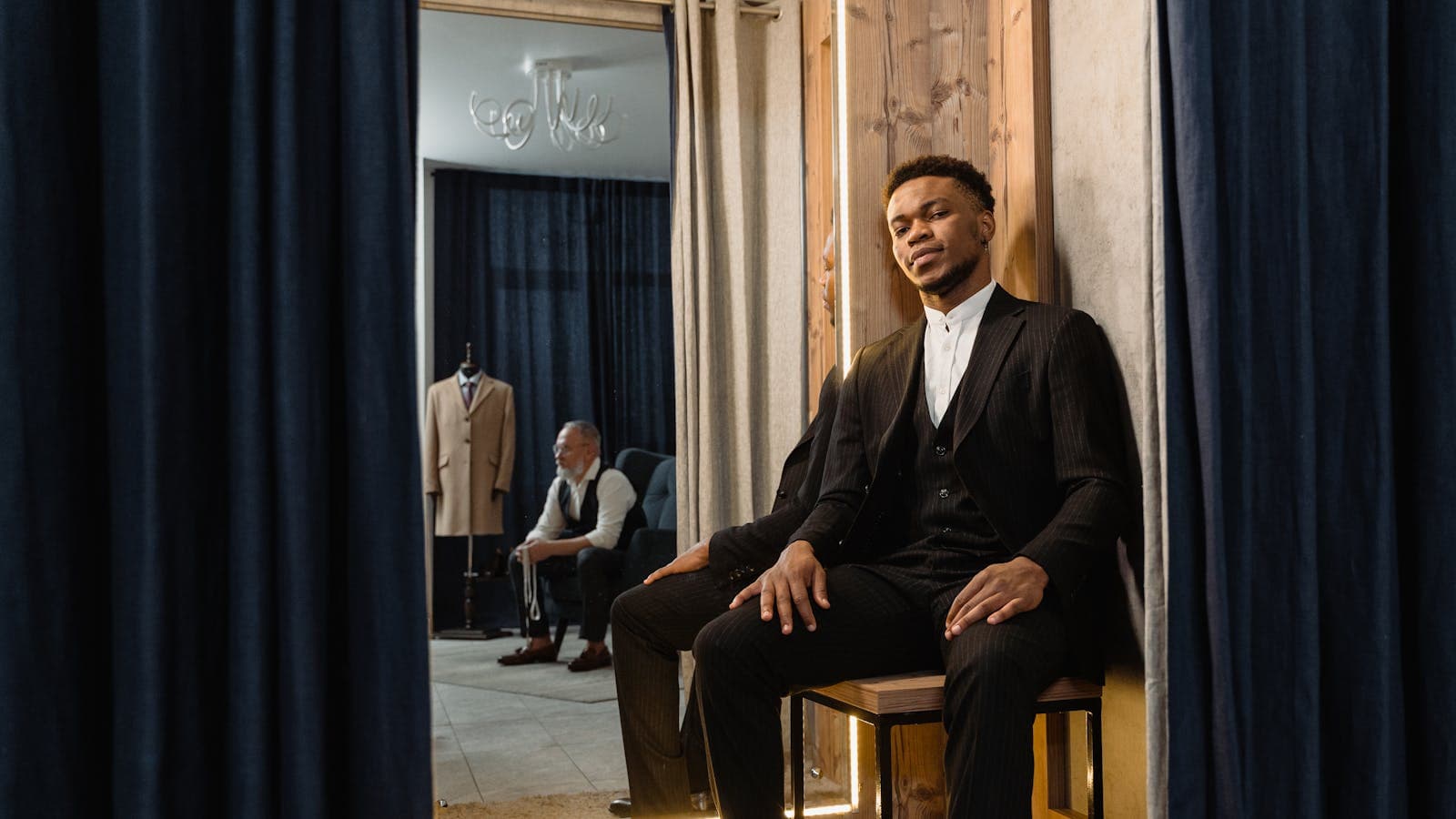
The short version is that we operate the way high-end European ateliers operated in the 1960s, before mass production changed what "custom" meant. Small team. Long-tenured tailors. Each suit touched by two or three specific pairs of hands from pattern to finish. Seam allowances built in so we can remake or adjust if the fit is not right. 200+ fabrics in the library, most of them from VBC, Marzotto, and Reda. No pattern cutting software. No factory line. The person who sewed your jacket knows your name.
What Celebrities Pay for "Art" at the Met Gala
Here is the table that should make the whole argument concrete.
| Element | Met Gala Couture (Custom Designer) | Savile Row Bespoke | Nathan Tailors |
|---|---|---|---|
| Fabric source | VBC, Loro Piana, Holland & Sherry | VBC, Loro Piana, Holland & Sherry | VBC, Marzotto, Reda |
| Pattern | From-scratch, fitted 2-3 times | From-scratch, fitted 2-3 times | Individual pattern, remote revisions |
| Canvas | Full canvas, hand pad-stitched | Full canvas, hand pad-stitched | Half-canvas standard, full canvas available |
| Lapel construction | Hand-rolled, pick-stitched | Hand-rolled, pick-stitched | Hand-rolled, pick-stitched |
| Labor hours per suit | 50-80 | 60-100 | 35-60 |
| Price | $8,000 - $40,000+ | $4,500 - $8,000 | $129 - $399 |
Look at the middle four rows. The construction is functionally identical. The labor hours are in the same order of magnitude. The fabric comes from the same mills. Now look at the last row. That is not quality. That is real estate, marketing, and margin structure.
The Met is not celebrating the $40,000 price tag. The Met is celebrating the craft. And the craft -- the pad stitching, the hand-rolled lapels, the proportional math, the Italian wool -- is available for $179 if you know where to order it.
Why This Matters More Than Usual in 2026
The broader menswear conversation has shifted in a way that makes this argument land harder than it would have five years ago. The skinny suit is dead. The soft-structured, proportional, adult silhouette is back. We wrote about that shift in detail here: Skinny suits are dead. And at the same time, there is a growing public appetite for provenance -- knowing where your clothes come from, who made them, whether the person who stitched the inner pocket was paid fairly.
The Met Gala on May 4 is going to amplify both of these shifts. You are going to see wide lapels, high-waisted trousers, double-breasted jackets, hand-finished details, rich fabrics in bold colors. You are going to see, essentially, a red carpet full of tailored construction. And the media is going to cover it as if a $15,000 designer jacket is the only way to participate in that conversation.
It is not. We wrote that companion piece already -- the "steal the look" version, with price comparisons for each of the five silhouettes that are going to dominate the 2026 red carpet. This post is the philosophical version. The takeaway is the same. The construction is the art. The construction is what we do. The label on the inside is where the price comes from, not the quality.
What You Can Do About This
If the "Fashion Is Art" dress code is speaking to you -- if the Met Gala coverage next week makes you think "I want to own something like that" -- here is the honest answer. You can. You do not need $15,000. You need 10 minutes of measuring, a Telegram conversation with our team, and about three weeks of patience.
Our process, in a paragraph. Take 15 body measurements at home using our visual measurement guide (about 10 minutes with a friend and a tape). Message us on Telegram. Send us a photo of the silhouette you want -- a red carpet look, a reference image, a description. We will walk you through the 200+ fabric library, help you pick lapel width and button configuration and trouser rise, and confirm the details. Your suit is hand-cut and hand-constructed in our Hoi An workshop over 2-4 weeks. DHL to your door in 5-7 business days. Seam allowances built in, free remakes if fit is off.
If it fits, and the lapel rolls the way a hand-rolled lapel rolls, and the chest drapes the way pad-stitched canvas drapes -- you will own a piece of the exact craft the Met is spending six months celebrating. For something in the $150-$300 range. In the same wool the designer houses use. From the same mills. With the same techniques the Savile Row cutters have been using since the 1840s.
That is the whole pitch. No magic. No gimmick. Just supply chain economics and 25 years of practice.
The Closing Argument
Walk into the Metropolitan Museum on May 5, the day after the gala. Pay the entry donation. Go up to the Costume Institute. Stand in front of the exhibition and look at the construction. The seams. The linings. The hand-finished edges. The places where cloth has been persuaded into shape through labor and time.
That is the art. That is what is being honored. That is what you can own, and wear, and pass on to whoever inherits your closet, for a fraction of what the gala coverage will claim it costs.
The Met Gala did not make tailoring art. Tailoring was art first. The gala just finally got around to saying it out loud. If you have been waiting for permission to dress like it matters -- permission to invest in a suit the way someone else might invest in a painting -- consider the permission granted. It was granted the first time a tailor pad-stitched a canvas into a piece of cloth and made it three-dimensional. Every suit after that has been a continuation of the same conversation.
Including the one we will make for you, if you message us on Telegram this week.
Own the Art, Not the Label
Custom suits in the same Italian wool the designer houses use, hand-constructed by tailors with 20+ years of practice, in our Hoi An workshop. From $129. Worldwide shipping via DHL. Message us on Telegram -- send a reference image, we will tell you exactly how we would build it.
25+ years | 420+ five-star Google reviews | 5,000+ clients across 50+ countries
Jay is a former Wall Street bond trader turned Nathan Tailors partner. After 10 years in the US -- Pennsylvania, New York, Houston -- he settled in Hoi An, Vietnam because the tailoring made more sense than the rent. He writes about the craft, the economics, and the reasons the price of a good suit has almost nothing to do with the quality of the work inside it. If you walk into the shop, Linda -- our Vietnamese Lady Boss -- will probably greet you with "Why are you so handsome?!" That is not a sales tactic. She says it to everyone. She also happens to know more about lapel rolls than most fashion editors.